
Data is Just the Table Stakes

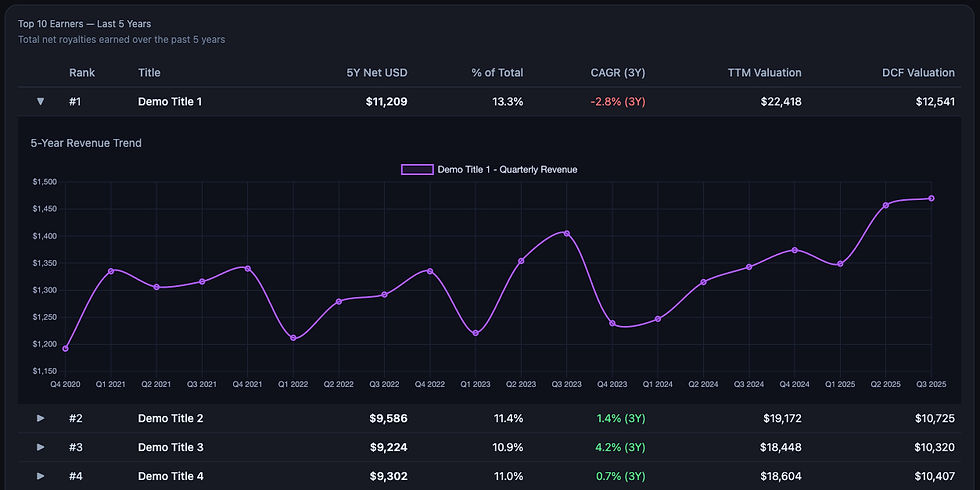
For years, conversations around music data have revolved around access- to global copyright databases, better royalty data, deeper DSP reporting (+ the terms of DSP licenses). Data in this framing is treated as a scarce resource- something hoarded, guarded, and used to justify competitive advantage.
The great news is the tide has shifted in recent years, meaning this framing no longer holds. Today, the ability to ingest, clean, reconcile, and analyse data at scale, and to contextualise it against broader market signals, is no longer a differentiator- it is simply the cost of entry. It is the Table stakes- the bare minimum required to participate seriously in the market.
What actually separates one fund or rights holder from another is not whether they can see the data, but how they model it. How they interpret it. How they turn it into defensible forecasts, valuation logic and conviction on their thesis.
In other words: the value no longer lives in the data itself, but in the intellectual layer that can be built on top. Interestingly the distinction is already being seen and exploited across other sectors.
Octopus Energy and the Myth of “Owning the Data”
When UK Energy giant Octopus built its internal technology platform, Kraken, it wasn’t trying to create a competitive weapon in the traditional sense. Kraken was designed to solve a deeply operational problem: how to manage complex energy usage, billing, and customer relationships in a modern, data-driven way.
Rather than treating Kraken as proprietary infrastructure that must be locked away, Octopus spun it out and began selling it to other energy companies- including direct competitors. Today, Kraken powers tens of millions of energy accounts globally, sitting at the operational core of multiple rival utilities. In fact, as founder Greg Jackson sometimes frames it, Octopus as an energy company itself was just a POC for selling the Kraken technology.
At first glance, selling a competitive advantage to the competition feels counter-intuitive. Why would a company willingly provide its competitors with the same data processing capability it uses itself?
Kraken doesn’t create competitive advantage because it has data. It creates a level playing field by allowing everyone to process data properly. The competitive edge lies elsewhere- in pricing strategy, customer acquisition, regulatory positioning, and long-term planning. Kraken is not the secret sauce, but the kitchen.
Music investment is in an analogous place. The tooling required to ingest royalty statements, compare against DSP reporting, reconcile society data and map catalog performance is no longer exotic, but is (... or should be) core infrastructure. A lack means simply being under-equipped. The advantage can only emergewhen this foundation is in place.
Formula One and Shared Data
There is no more intensively competitive environment or industry than Formula One. Teams are notoriously secretive- even to the level of hiding their clipboards and printouts from competitor’s photographers (while sending out their own photographers to see what they can capture!). In F1, the same fundamental race data is accessible to every team- lap times, sector splits, tire performance, weather conditions- none of this is exclusive. What differentiates winning teams from the rest is not access, but strategic interpretation.
James Vowles, now Team Principal at Williams, spent years at Mercedes as head of Race Strategy- including helping to develop proprietary software the Pit Wall could use to consolidate and analyse data during a race- dubbed ‘RaceWatch’. Is it still proprietary? You guessed it- now over 50% of the teams on the grid license the software.
As F1 strategist Bernie Collins puts it in her book How to Win a Grand Prix, "The intellectual property in strategy is actually the model you put in". The underlying data? It’s just table stakes.
The insight maps perfectly onto music investments. Every serious fund can see historical streaming numbers, and has access to data rooms filled with royalty statements. Many now pull audience, playlist, and geographic data from third-party providers, or cross reference metadata via DSP APIs. The data is there, and is ready to be put to work.
The competitive edge lies in how Funds model the data they have access to- decline curves, stress-tested assumptions, how platform risk is incorporated, how catalog behaviour is forecasted across time, territory, and genre. Two funds can start with identical datasets and reach radically different conclusions- not because one “has better data,” but because one has better, or more evolved, modelling.
The Growing Availability of Music Data Changes the Game
This shift is accelerated by the simple fact that music data is becoming more available. DSPs continue to expand their reporting surfaces (whether via APIs or partner integrations), and as explored previously CMOs are also slowly improving transparency.
Third-party providers aggregate, clean, and contextualise usage data at global scale. Meanwhile public, open source, datasets- from Discogs to MusicBrainz to Genius- provide increasingly rich structural and metadata layers. At the very least these are excellent sources for cross referencing other “first hand” data.
None of this eliminates complexity, but it does eliminate the idea that data itself is rare. As availability increases, the market stops rewarding having information and starts rewarding making sense of it faster and more accurately than others. This is the same inflection point as in energy, finance, logistics, and sport.
Infrastructure First, Differentiation Second
All of this leads to a simple but uncomfortable conclusion for funds. If you don’t have the infrastructure to ingest, reconcile, and model data at scale, you are operating below the market baseline.
Modern analytical capability- whether built internally or adopted externally- are no longer optional. They are the equivalent of Kraken in energy or RaceWatch in Formula One, allowing everyone to sit at the table. The advantage is built through the modelling layered on top, and by the people who understand how to evolve them as the market changes.
The risk for music investment funds today is not that competitors will have access to more, or better data. The real risk is failing to make best use of what is available.
In our data driven world intuition alone isn’t enough. Much like with A&R, it’s simply underpowered. Data will continue to commoditise, and in the next phase of music investment, it won’t matter who has the data, but who knows how to use it.


Comments