
The Blindfolded Investor

Imagine trying to value a ring in a jewellery store, but wearing a blindfold. You can sense the outlines, feel the cut of the stone and setting, but the fine detail- the information that actually determines whether you’re about to buy a diamond or a dud- is obscured.

That’s where many funds still find themselves today. Investment decisions are often made with incomplete or unreliable data. Acquisition packs are full of disparate (and static) spreadsheets, poorly formatted PDFs and patchy royalty statements. The latter are often the best/most reliable source of information- but newer platform trends still won’t be visible until long after the revenue has already been delivered.
In this context, having a robust technology and data strategy is no longer “back office”, but central to value creation. For funds investing in publishing catalogs in particular the competitive edge lies not simply in the deals they close, but in the clarity of the data underpinning and informing those deals, and in the systems that can transform raw usage into actionable insight.
Data ALWAYS Matters
Music publishing revenues arrive fragmented, delayed and opaque. A single catalog can earn from hundreds of sources, and via many differing routes- collecting societies, DSPs, UGC platforms, syncs, live performances, broadcast (both linear and digital, TV and radio) and more. Each source provides data in a slightly different format, on a slightly different timescale, with slightly different levels of granularity (anecdotally I've seen many a royalty statement previously where the lion's share of revenue was attributed simply to "the Internet", with no more detail available on source/platform!).
Without a data transformation layer- normalising incoming data into a consistent format that insights can be built upon- funds risk three key things:
Overvaluing assets. Inaccurate or overly optimistic forecasts that inflate acquisition prices. When the real numbers arrive years later, returns will disappoint.
Missing emerging opportunities. Whether it’s growth in a new territory, virality on a UGC platform, or AI licensing, data blind spots mean missed upside.
Slow recognition of leakage. Unmatched or unclaimed royalties are an endemic issue in publishing. Without clear data visibility, funds may not even realise the scale of their own leakage. No one likes to leave money on the table, but this is even more crucial for funds and their investors with a keen eye on ROI.
In other words, the question is no longer “do you have a good pipeline of deals?” but “do you truly understand what you’re buying- and can you prove it in real time to your LPs?”
Building a Tech Strategy: Risk Mitigation
For many funds, “tech strategy” has historically meant focussing on ensuring royalties are collected properly- effectively income tracking. That is the baseline, but only provides a foundation for where a deeper competitive advantage can be built.
A forward-looking tech strategy for publishing investments should include:
Forecasting tools. Streaming and UGC data can be used to spot trends before they hit royalty statements. Predictive analytics can model likely growth in emerging markets, or estimate the potential upside of AI licensing opportunities.
Derivative tracking. Were rights to derivatives acquired? Uncleared samples and interpolations can often generate more revenue than their parent copyright- but only if they’re registered correctly (and, in all places!)
Checking all assets are registered. There’s the schedule of works from the seller, what’s on the royalty statements, what’s registered at the publisher AND at the PRO. Do all these lists align?
Benchmarking assets. How does your catalog perform relative to peers? Without comparative data, it’s impossible to know if underperformance is due to market shifts or poor exploitation.
Attribution and matching. Clean pipelines between ISWC, ISRC, and usage data are critical. The more automated and accurate the matching, the less revenue slips through the cracks.
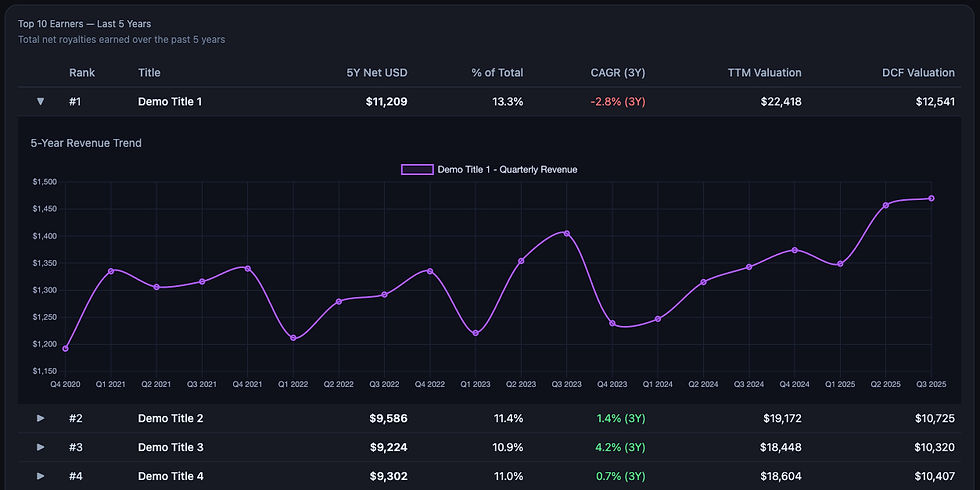
Transparency dashboards. Real-time reporting isn’t just for internal teams. LPs increasingly expect funds to provide visibility on performance, revenue streams, and growth. Transparency goes beyond good governance, to a competitive differentiator for raising new capital.
Each of these components turns static IP into dynamic assets. The catalog isn’t just a pile of rights sitting on the balance sheet but a living, breathing data asset that can be compared, forecasted, and critically- optimised.
Funds that don’t focus on building out an integrated tech strategy also face structural risks. They become dependent on third parties to provide visibility, often not seeing problems until too late. They cannot explain to LPs where growth is coming from or how performance compares to the wider market- or where opportunities might lie to increase an asset’s performance.
In a market where multiples are high (though deflated from the heady Hipgnosis days) and margins are increasingly tight, that lack of visibility creates a material disadvantage. Particularly when those 3rd parties also have their own assets to focus on (e.g. major labels). As a service provider they have an obligation, but if it’s a straight fight between an asset where they have 50% margin vs. 10% it’s not hard to see where their focus will be (which also is true throughout income tracking and revenue recovery).
LPs and co-investors are asking sharper questions about reporting and performance attribution. Newer funds that can provide sophisticated dashboards and real-time transparency are becoming increasingly attractive, while those still reliant on static PDFs run the risk of being left behind.
From Passive to Proactive Investment
In summary, the biggest shift that data enables is a move from passive to proactive investment.
Without data, a fund is essentially a passive royalty collector. Depending on its acquisition strategy it buys catalogs, waits for statements, and collects revenues- whatever they might be. Performance depends largely on forces outside its control.
With data, that same fund can transform into a proactive, and far more profitable, venture. We all know how much ongoing management is required for publishing assets (particularly with recording matching and global registrations/collections), but even just access to real-time usage reporting provides a springboard for maximising every asset in a portfolio:
Spot usage trends early and adjust marketing or sync strategies accordingly
Identify revenue gaps and push administrators to resolve them
Compare performance across catalogs and identify which are under-exploited
Model likely returns under different streaming or licensing scenarios, enabling more informed acquisition decisions (e.g. the latest BMI rate improvement for Radio could be modelled and the impact on a fund predicted)
This is a profound shift. It turns music publishing from a bond-like instrument- a static annuity that pays out at a fixed rate- into a dynamic asset class that can be optimised for growth.
What a Difference Data Makes
The difference, as always, is data.
With no data strategy, a fund is blindfolded- hoping for upside, vulnerable to leakage, unable to prove performance to investors.
With a strong data strategy, the blindfold comes off. Catalog investments can be priced more accurately. Revenue opportunities can be seized earlier. LPs have transparency. Music Funds (particularly those with publishing interests) can operate with the same level of confidence and sophistication as any other institutional asset class.
The question for funds is no longer “do you have a pipeline of deals?” but “do you have a data strategy?”.
In today’s music market, what you know about what you own is every bit as important as the assets themselves.


Comments